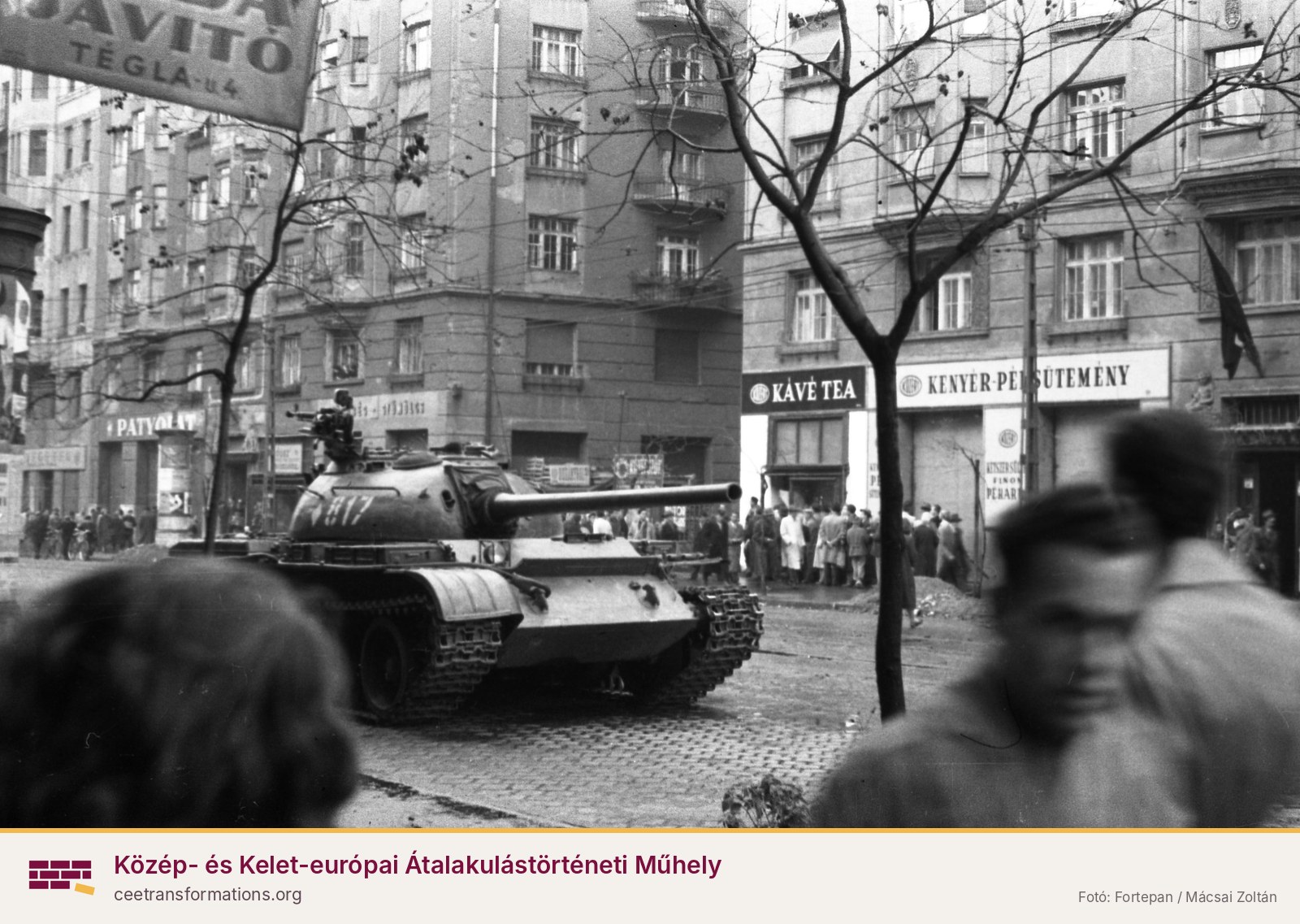
“Today at daybreak Soviet troops attacked our capital with the obvious intent of overthrowing the legal democratic Hungarian government.”
Imre Nagy, radio address, 4 November 1956
Seventy years ago, on the afternoon of 23 October 1956, university students gathered at the statue of General Bem in Budapest to stand by the Polish people. By evening, the crowd had become the voice of the whole nation. Hundreds of thousands demanded freedom in front of Parliament, Stalin’s statue was toppled in the City Park, and the first shots rang out at the Radio building. What had begun as a demonstration of solidarity became a revolution within hours: a nation that, barely a decade after the war and under the weight of occupation and dictatorship, dared once again to raise its head for freedom.
For thirteen days the impossible seemed within reach. Workers’ councils and revolutionary committees were formed, prison gates were opened, and the Imre Nagy government declared Hungary’s neutrality. But at dawn on 4 November the Soviet tanks returned. In the streets of Pest, teenagers and workers confronted one of the most powerful armies in the world. Thousands fell, some two hundred thousand left their homeland, and the reprisals claimed 229 lives, among them that of Imre Nagy.
The revolution was crushed, but it could not be undone. 1956 left its mark on an entire era. The Kádár regime was built on the suppression of the revolution and for thirty-three years could not escape its shadow. When, on 16 June 1989, hundreds of thousands bade farewell to Imre Nagy and his fellow martyrs in Heroes’ Square, the revolution finally triumphed: its ideals became a cornerstone of the democratic transition.
1956 is not only a Hungarian story. Intertwined with the Polish October, it was the first great attempt by Central and Eastern Europe to take its fate into its own hands. The peoples of the region took up this thread again in 1968, 1980 and 1989.
Seventy years on, we pay tribute to the heroes and victims of the revolution. Their memory obliges us.
Featured image: Fortepan / Mácsai Zoltán